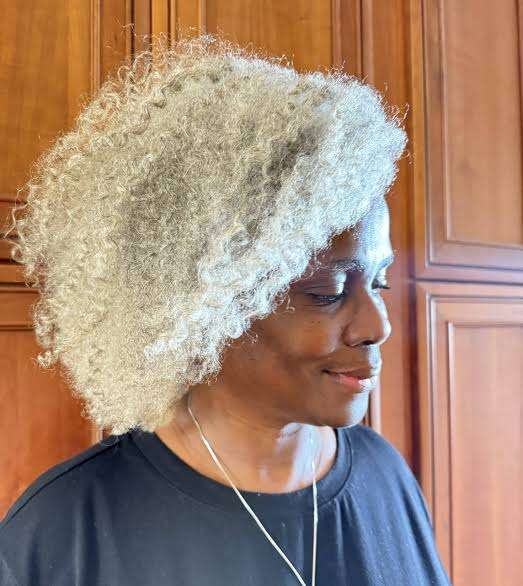
CurlyNikki Says: My mother has low-porosity hair, while my daughter and I have high-porosity strands. Her hair THRIVES with Oyin Handmade’s entire lineup, especially the lighter, water-based leave-ins, and super especially, the Hair Dew – which is a product that we can both agree on! She has used them exclusively for 6 years, and her hair has gone from heat-damaged and collarbone-length when stretched to thick, healthy, and bra-strap length using their shampoo, detangling conditioner, and styling creams and leave-in sprays. She also uses a castor oil/water spray when re-moisturizing mid-cycle. She keeps her hair in twists unless she is out and about, and sleeps in a bonnet religiously. Her hair is fully silver, and the wiry texture that used to work against her loves her, and she loves it! Watching her low-porosity hair blossom with this predictable and beautiful routine with Oyin has been awesome!
11 Best Products for Low Porosity Hair in 2026 That Actually Absorb
by Team CurlyNikki
There is a special kind of frustration that comes from applying an entire moisturizing routine only to discover that most of it appears to be sitting on your hair. Your curls look coated. Your roots feel heavy. Your ends somehow still feel dry.
If that sounds familiar, the problem may not be that you need more moisture. You may need products that your hair can actually work with. Low-porosity hair has a relatively compact cuticle structure that can make it more difficult for water and conditioning ingredients to move into the hair fiber. That doesn’t mean low-porosity hair is inherently unhealthy or even curly. Porosity and curl pattern are different characteristics, and low porosity can occur across textures.
What it does mean is that product selection matters. The best products for low-porosity hair tend to favor hydration without unnecessary weight. Think fluid leave-ins, strategic clarifying, lighter styling products and formulas that don’t require you to coat your hair in layer after layer of butter and oil.
That’s also why we didn’t simply assemble a list of the richest products we could find. Our picks prioritize useful formulations, manageable textures and products that address the problems low-porosity hair commonly runs into, particularly buildup, slow absorption, dryness and the eternal question of why your expensive conditioner appears to have taken up permanent residence on top of your hair.
The Best Products for Low-Porosity Hair at a Glance
- Ouidad Advanced Climate Control Defrizzing Shampoo – Best Shampoo
- K18 Peptide Prep Detox Shampoo – Best Clarifying Shampoo
- Ceremonia Guava Leave-In Conditioner – Best Leave-In
- Ouidad Curl Quencher Moisturizing Conditioner – Best Conditioner
- Pattern Detangling Nectar – Best Detangler
- Adwoa Beauty Melonberry Hair Milk Leave-In Conditioner – Best Hair Milk
- Pattern Palo Santo Curl Mousse – Best Mousse
- Adwoa Beauty Melonberry Vitamin C Frizz-Fighting Hair Gel – Best Gel
- Bread Beauty Supply Hair Oil Everyday Gloss – Best Finishing Oil
- Sienna Naturals Plant Power Repair Mask – Best Mask
- K18 Leave-In Molecular Repair Hair Mask -Best for Damaged Low-Porosity Hair
1. Ouidad Advanced Climate Control Defrizzing Shampoo – Best Shampoo
Low-porosity hair doesn’t need to be stripped within an inch of its life every wash day. It does, however, need to be cleaned well enough that yesterday’s styling products aren’t preventing today’s conditioner from reaching the hair.
Ouidad Advanced Climate Control Defrizzing Shampoo is a sulfate-free cleanser formulated for curl types 2A through 4C. Ouidad says the formula uses ceramides alongside shea and murumuru butters and is designed to cleanse without stripping the hair.
Why does it make sense here? It sits in the useful middle ground between an ultra-gentle cleanser that may leave too much behind and a serious clarifying shampoo you wouldn’t necessarily reach for every wash.
Low porosity doesn’t automatically mean you should avoid every rich ingredient. Formula, concentration and how a product rinses matter more than ingredient-list absolutism. This is a cleanser, not a jar of butter you’re leaving on your hair for five days.
Best for: Regular wash days, curls prone to frizz, people who need a real cleanse without jumping straight to a detox shampoo.
2. K18 Peptide Prep Detox Shampoo – Best Clarifying Shampoo
If products suddenly seem to have stopped working, clarify before you buy six more products.
That advice matters particularly for low-porosity hair because buildup can create an additional barrier on hair that already resists easy saturation.
K18’s Peptide Prep Detox Shampoo is designed to remove product buildup, excess oil and impurities. This is the reset step rather than the everyday shampoo.
How often you need it depends on what you’re putting on your hair. Someone layering gel, edge control, oils and creams may need to clarify more frequently than someone using a leave-in and mousse.
Best for: Persistent buildup, heavy stylers, oily roots, hair that feels coated after washing.
3. Ceremonia Guava Leave-In Conditioner – Best Leave-In
A good low-porosity leave-in should disappear into the routine instead of announcing itself for the next three days.
Ceremonia’s Guava Leave-In Conditioner has the lighter profile we want for this job. It conditions and helps with detangling and heat protection without requiring the dense, butter-heavy texture that can overwhelm hair prone to buildup.
Apply it to wet hair rather than waiting until your strands are halfway dry. Water should be doing much of the hydration work; the leave-in helps condition and maintain that softness.
And start with less than you think you need. You can always add another small amount. Removing half a bottle of leave-in from low-porosity hair is a more complicated afternoon.
Best for: Wash-and-gos, lightweight conditioning, curls that become greasy or limp under heavy creams.
4. Ouidad Curl Quencher Moisturizing Conditioner – Best Conditioner
The trick with low-porosity hair is not avoiding moisture. It’s delivering moisture without leaving so much residue behind that the next wash day becomes an excavation.
Ouidad’s Curl Quencher collection is designed for tighter curls, and its moisturizing conditioner makes sense for people who need more conditioning than a very fine or wavy low-porosity texture might tolerate.
This is particularly interesting for tighter textures because low porosity and 4C hair can coexist. Someone with dense coils may still need considerable slip and conditioning even when the individual strands resist product absorption.
Best for: Tight curls, thirsty hair, low-porosity textures that find ultra-light conditioners insufficient.
5. Pattern Detangling Nectar – Best Detangler
Detangling is one category where slip can be more important than sheer richness.
Pattern’s Detangling Nectar is designed to give hair glide while loosening tangles, making it particularly useful before or during a wash routine when the goal is to reduce unnecessary pulling and breakage.
That matters for tightly curled low-porosity hair. You don’t necessarily need a heavier product. You need enough lubrication to get your fingers or tool through the hair without a fight.
Use it as a functional detangling step rather than treating it as another moisturizing layer that must remain on the hair indefinitely.
Best for: Knots, wash-day detangling, dense curls and coils, reducing mechanical stress.
6. Adwoa Beauty Melonberry Hair Milk Leave-In Conditioner – Best Hair Milk
Hair milk is one of the most useful product formats for low porosity because it occupies the space between a mist and a cream.
Adwoa Beauty’s Melonberry Hair Milk gives you that middle ground: enough conditioning to matter without immediately reaching for a thick butter.
For low-porosity curls, that can be particularly helpful during warmer weather or anytime a full cream-and-oil layering routine leaves hair feeling coated.
Apply to thoroughly wet hair, work in sections and give the product a chance to distribute before deciding you need another handful.
Best for: Curls and coils that need more than a spray but less than a heavy cream.
7. Pattern Palo Santo Curl Mousse – Best Mousse
Mousse has become one of the more interesting categories for curl care because it can deliver definition and volume without the density of traditional creams.
Pattern’s Palo Santo Curl Mousse is a strong option for someone whose low-porosity curls look great immediately after styling but become flat once several layers of product dry.
A mousse can also be useful for refreshing, depending on your routine, because you can restore some shape without rebuilding your entire wash-day product stack.
Best for: Volume, lighter definition, fine-to-medium strands, anyone tired of weighed-down curls.
8. Adwoa Beauty Melonberry Vitamin C Frizz-Fighting Hair Gel – Best Gel
Low porosity doesn’t mean giving up hold.
The goal is to find a styling product that can create definition without forcing you to put a heavy cream, butter and oil underneath it first.
A gel-centered routine can actually simplify things. Try leave-in plus gel, or even gel alone over soaking-wet hair if the formula and your texture allow it. Then evaluate the result before adding another layer.
This is also one reason product experimentation should be controlled. If you’re changing four products simultaneously, you’ll never know which one created the buildup.
Best for: Wash-and-gos, frizz control, definition and routines built around fewer layers.
9. Bread Beauty Supply Hair Oil Everyday Gloss – Best Finishing Oil
Oil is where low-porosity advice tends to become unnecessarily dramatic.
You do not need to ban oil from your bathroom.
You do need to understand what oil is doing.
Oil is not a substitute for water. For low-porosity hair, piling a heavy oil onto dry strands can make the hair feel coated without solving the underlying hydration problem.
A lighter finishing oil such as Bread Beauty Supply Hair Oil makes more sense when used sparingly for shine, softness and finishing rather than as the foundation of the moisturizing routine.
A few drops means a few drops.
Best for: Finishing, shine, smoothing ends and people who want oil without a heavy coating.
10. Sienna Naturals Plant Power Repair Mask – Best Mask
Low-porosity hair can still need a treatment.
Sienna Naturals Plant Power Repair Mask is an appealing option for curls and coils that need conditioning and strengthening without turning every wash day into an exercise in layering the richest products available.
A mask is also where technique can matter almost as much as product selection. Saturate the hair thoroughly, distribute the treatment evenly and follow the manufacturer’s directions rather than simply leaving it on for half the day because longer feels more serious.
It isn’t.
Best for: Periodic treatment days, dry curls, coils needing more conditioning than an everyday conditioner provides.
11. K18 Leave-In Molecular Repair Hair Mask – Best for Damaged Low-Porosity Hair
Low porosity and damaged hair are not synonyms.
That distinction matters.
If your hair is low porosity but otherwise healthy, you do not automatically need bond repair. If it has also been bleached, chemically processed or repeatedly exposed to high heat, then a repair product may deserve a place in the routine.
K18’s Leave-In Molecular Repair Hair Mask uses the brand’s peptide technology and is applied after shampooing. The lightweight leave-in format is particularly appealing for hair that doesn’t enjoy being buried under a traditional heavy mask.
For a much deeper look at this category, see our guide to the best bond-repair treatments for 4C and natural hair.
Best for: Bleached, color-treated, chemically processed or significantly heat-damaged hair.
How We Chose the Best Products for Low-Porosity Hair
We looked for products that address the practical problems associated with low-porosity hair rather than treating “low porosity” as a marketing category.
That means prioritizing cleansing where buildup is a concern, lighter leave-on textures, effective detangling and styling products that can work without an elaborate stack underneath them.
We also considered textured hair specifically.
That’s important because low porosity isn’t a curl type. Advice written for someone with fine, straight low-porosity hair doesn’t automatically translate to dense 4C coils. A tightly coiled head of hair may need considerably more conditioning and detangling support while still benefiting from careful product layering.
What Is Low-Porosity Hair?
Low-porosity hair has a cuticle structure that makes it relatively difficult for water and other substances to move into the hair fiber.
Common signs can include water seeming to bead on the hair, products sitting on the surface and hair taking a long time to become fully saturated.
If you want the science and routine rather than another shopping list, read our complete guide to low-porosity hair and how to moisturize it.
That’s where the informational intent belongs. This page is deliberately about choosing products.
Can 4C Hair Be Low Porosity?
Absolutely.
4C describes curl pattern. Porosity describes how readily the hair interacts with and takes up moisture and other substances.
They are not competing classifications.
You can have low-porosity 4C hair, high-porosity 4C hair or something between those extremes.
The important practical difference is that tightly coiled hair often benefits from significant conditioning and slip. So “use the lightest possible product” isn’t universally useful advice for low-porosity 4C hair.
The better goal is enough conditioning without unnecessary accumulation.
For more Type 4-specific advice, see our 4C hair guide.
What Ingredients Are Good for Low-Porosity Hair?
Water-based formulas are an obvious place to start.
Humectants such as glycerin can also be useful because they help attract water, although the performance of any single ingredient depends on the complete formula and environment.
The larger lesson is not to shop by ingredient mythology.
A product containing shea butter isn’t automatically terrible for low-porosity hair. A product labeled “lightweight” isn’t automatically perfect. Concentration, formulation, how much you apply, what you layer with it and how thoroughly you cleanse all matter.
Should Low-Porosity Hair Avoid Protein?
Not automatically.
The internet has turned “low porosity hates protein” into something approaching hair-care law, but porosity alone doesn’t tell you whether your hair will benefit from or dislike a particular protein-containing formula.
Hair that is damaged from chemical processing may have very different needs from healthy low-porosity hair.
Pay attention to how your own strands respond rather than building your entire routine around a blanket rule.
How Often Should Low-Porosity Hair Be Clarified?
There isn’t one schedule that works for everyone.
Someone using multiple stylers, oils, edge control and dry shampoo may accumulate residue much faster than someone using two lightweight products.
Clarify when your regular cleansing routine is no longer removing buildup effectively. Signs can include dullness, persistent coating, products behaving differently than usual and hair that still doesn’t feel clean after washing.
Is the Float Test an Accurate Way to Check Hair Porosity?
Treat it as a rough experiment rather than a laboratory diagnosis.
Residue on a strand, surface tension and other variables can affect whether hair floats or sinks in a glass of water.
Your hair’s repeated behavior is often more useful: how easily it saturates, how products absorb, how quickly buildup develops and how the hair behaves after cleansing.
The Bottom Line
Low-porosity hair doesn’t need more stuff.
It needs a routine in which each product has a reason to be there.
Clean thoroughly enough to prevent buildup. Condition according to your actual texture and density. Apply leave-ins to wet hair. Choose stylers that give you the result you want without requiring four other products underneath them.
And when your hair feels dry and coated at the same time, resist the natural-hair reflex to add another layer.
Sometimes the answer is not more product.
Sometimes it is shampoo.
READ MORE
Low Porosity Hair: What It Is and How to Moisturize It Properly
9 Best Bond Repair Treatments for 4C and Natural Hair in 2026
9 Best Gels for 4C Hair in 2026
The Best Shampoo and Conditioner for Curly Hair: 2026 Top Picks