by Team CurlyNikki for CurlyNikki.com
It’s one of those classic dinner-table debates: Where did those curls come from? If you’ve ever looked at your own reflection, or your child’s, and wondered why your texture looks nothing like your parents’, you’re tapping into one of the most fascinating “glitches” in human genetics. Let’s break down the science of the spiral.
Is Curly Hair Dominant or Recessive? (The Short Answer)
In the simplest terms of high school biology: curly hair is considered a dominant trait, while straight hair is recessive.
In a “perfect” Mendelian world (think back to those pea plant experiments), this would mean that if you have one “curly” gene and one “straight” gene, you would automatically have curly hair. The curly gene would simply “boss” the straight one into submission. However, as we’ve learned from the millions of women with beautiful beachy waves, hair genetics isn’t always that black and white.
The “Incomplete Dominance” Twist: Why Wavy Hair Exists
If curly hair were perfectly dominant, wavy hair wouldn’t exist, everyone would either have ringlets or pin-straight strands.
Instead, hair texture is a prime example of incomplete dominance. Think of it like mixing paint. If “Curly” is red and “Straight” is white, the person with one of each doesn’t end up red; they end up pink. In hair terms, that “pink” is wavy hair.
- HH (Homozygous Dominant): You have two curly genes. Result? Very curly or coily hair.
- ss (Homozygous Recessive): You have two straight genes. Result? Straight hair.
- Hs (Heterozygous): You have one of each. Result? The wavy “middle ground” we see so often.
The Biology of a Bend: How Your Follicles Are Shaped
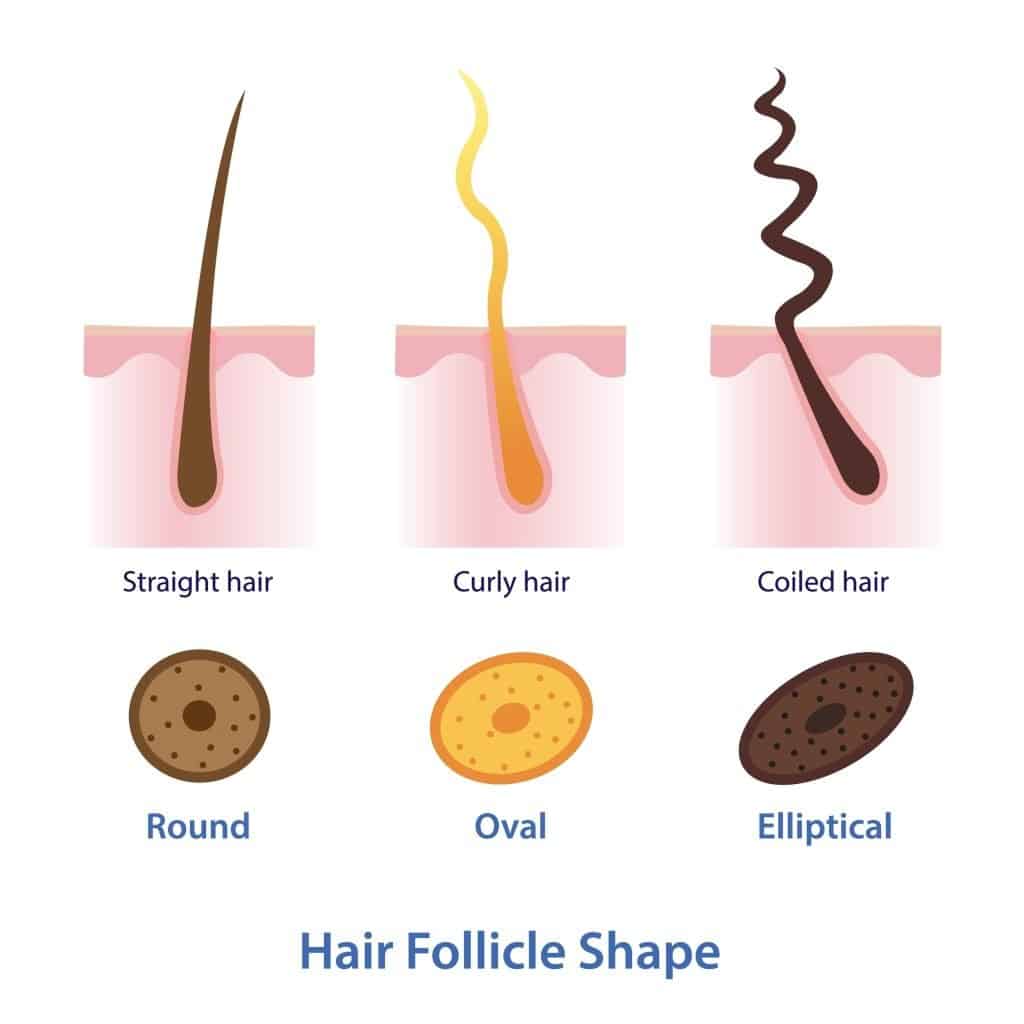
Genetics isn’t just a code; it’s a blueprint for the physical shape of your scalp. Whether your hair is dominant or recessive actually dictates the shape of your hair follicle, the tiny “tunnel” in your skin that your hair grows out of.
- Round Follicles: These produce straight hair. The hair grows straight up and out with no resistance.
- Oval or Flat Follicles: These produce curly hair. Because the “tunnel” is asymmetrical or flattened, the hair has to “fold” or curve as it grows out, creating a spiral.
The flatter the follicle, the tighter the curl. It’s a literal physical manifestation of your DNA!
Can Two Straight-Haired Parents Have a Curly-Haired Child?
Believe it or not, yes! This is exactly what happened with my cousin Maya.
While straight hair is recessive, genetics is polygenic, meaning it involves more than just one single gene. There are at least ten different genes that play a role in your final texture. Sometimes, a “curly” gene can remain “hidden” or unexpressed for generations, only to reappear when the right combination of alleles meets during conception. If both parents carry a “hidden” wavy or curly allele that wasn’t strong enough to show up in their own hair, their child can absolutely hit the genetic jackpot and end up with curls.
Why Your Hair Texture Might Change Over Time
We’ve all heard the stories: “I had straight hair until puberty,” or “My curls disappeared after I had my baby.” If hair is genetic, shouldn’t it stay the same?
While your genotype (your DNA) never changes, your phenotype (how that DNA shows up) can be influenced by hormones. Hormones like estrogen, insulin, and cortisol can actually flip “switches” in your body that change the shape of your hair follicles or the way your proteins are distributed. This is why major life shifts can lead to a completely new curl pattern.
Embracing Your DNA
Whether you inherited a dominant ringlet or a recessive strand, your hair is a physical legacy of the people who came before you. At CurlyNikki, we believe that understanding the why behind your hair helps you better love the what. You aren’t fighting your hair; you’re just learning to work with the unique blueprint nature gave you.
FAQ: Your Top Hair Genetic Questions Answered
Which parent determines if hair is curly?
Neither parent is solely responsible. You inherit one set of hair-texture genes from your mother and one from your father. The combination of these two determines your final look.
Is 4C hair dominant?
Generally, coily and kinky textures (Type 4) are part of the dominant spectrum. However, the intensity of the curl is influenced by multiple genes working together.
Why is my hair curly underneath but straight on top?
This is often due to “differential gene expression” or environmental factors. The hair on top is more exposed to heat, sun, and mechanical damage, which can loosen the pattern, while the protected hair at the nape stays true to its genetic “curly” roots.
Can you turn straight hair curly permanently?
Genetically, no. You can use chemicals (like a perm) to change the shape of the disulfide bonds in your hair, but as soon as new hair grows from the follicle, it will revert to its original genetic blueprint.
Is curly hair more common than straight hair?
Globally, wavy and curly hair types are actually more prevalent than pin-straight hair, though it varies significantly by ethnicity and region.
READ MORE:
Daily Devotional March 23: Everything Begins Today.
Daily Devotional for March 22, 2026 | Messages from the Holy Spirit
Daily Devotional for March 21, 2026 | Messages from the Holy Spirit
Daily Devotional for March 20, 2026 | Messages from the Holy Spirit
15 Bible Verses for Wealth, Financial Peace, and Prosperity
31 Healing Scriptures for Health and Strength
Prayer for Healing : The Word That Works Swiftly and Powerfully
FOLLOW NIKKI ON IG!